Finding the right protein powder in Australia can be confusing, with numerous types, brands, and price points.
This guide breaks down everything you need to know, from whey and plant-based options to protein content, ingredients, and cost per serve.
Whether you’re training hard, short on time, or just want to make sure your protein powder is worth it, this practical buyer’s guide will help you pick a safe, effective, and affordable option.
Table of Contents
Disclaimer: This information is for educational purposes only and is not intended as medical advice. Always consult a qualified healthcare professional before making changes to your diet or supplementation.
Protein Powder in Australia: Safety & Regulation
Protein powder in Australia is classed as a food, specifically a Formulated Supplementary Sports Food under FSANZ (1,2).
It’s not a drug or medicine, just a high-protein food that’s been processed and concentrated, similar to powdered milk or flour (3).
Australian regulations set minimum safety standards for food products, but quality can still vary between brands.
Research shows that protein supplements are generally safe when used as intended and can have numerous health benefits (4).
Trace contaminants, including heavy metals, can occur in protein powder in Australia, just as they can in many everyday foods. This has been shown in large independent testing (5).
Health risks appear to depend more on product quality, farming and manufacturing than on protein powder itself (6).
TIP:
Heavy metals exist in the entire food system. Protein powder is not uniquely dangerous.
What to Look For When Buying Protein Powder
This framework is specific to how to buy protein powder in Australia, but the same principles can be applied anywhere to choose a protein powder that fits your fitness goals, dietary needs, price range, and purity while providing the best value.
If you need a single reference point, whey concentrate is a common starting option because it provides complete protein, is widely available, and is typically quite affordable compared to more processed or premium options.
This is not a recommendation for everyone and does not account for dietary restrictions, allergies, or specific goals.
That is where other options come into play, with plant-based or specific whey protein powders, which we will break down next.
Choosing the Right Protein Powder
Consuming the right amount of daily protein is the first step. A safe average is 1.6 grams of protein per kilogram of body weight per day. For more detail see our guide: Protein Essentials: What, When, and How Much
Choosing the right type of protein powder is next.
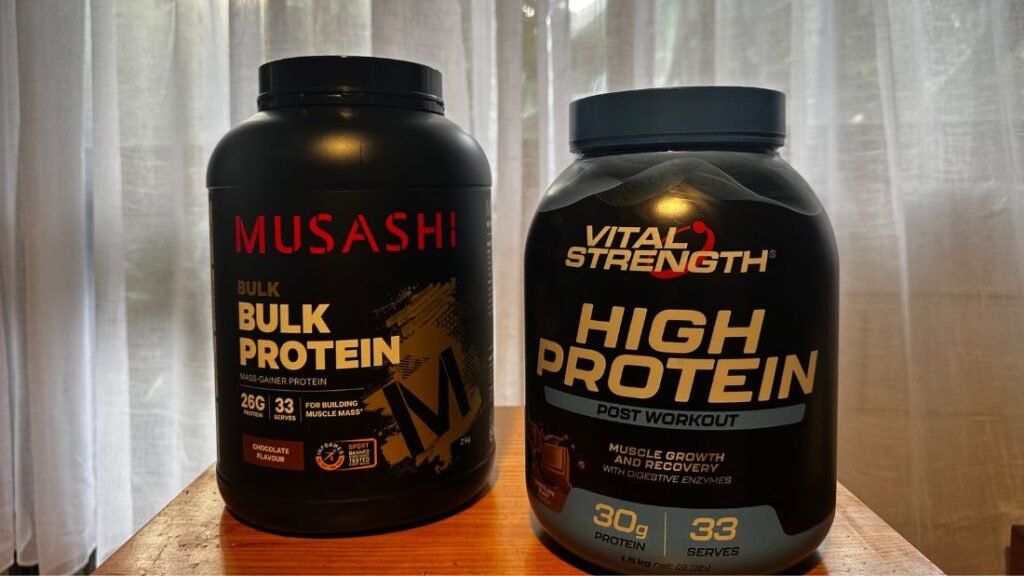
The image above shows two tubs of protein powders with very different purposes. The one on the left is a bulk whey protein option, I grabbed when it was ridiculously cheap; it works well for me while hybrid training and needing extra calories, but it wouldn’t be my choice for everyday use.
The one on the right was a whey concentrate and was for my dad, who wanted an everyday use protein for breakfast or a snack.
Other goals, like weight loss, specific diets, or food tolerances, can also determine which type you choose.
The table below brings together the five most common types, typical prices, value and what each type is best used for to help you find the right one.
| Protein Type | Goal | Typical Price (1kg) | Protein per 100g | Key Notes |
| Whey Concentrate (WPC) | Muscle gain, recovery, and general everyday protein needs. | ~$40–60 | 60–70% | Milk-derived, contains some carbs, fats and lactose; good taste & texture. The most common type of whey protein. Is usually the cheapest. |
| Whey Isolate (WPI) | Higher protein per serve, weight loss/cutting, muscle gain, very lactose-sensitive. | ~$70–80 | 80–95% | Milk-derived, fewer calories and even less carbs and fats, very low lactose. More filtered than whey concentrate and usually more expensive. |
| Casein | Long gaps between meals, overnight protein, and appetite control | ~$50–70 | 60–70% | Milk-derived, Slow-digesting, more filling, some lactose. Usually priced similar to or slightly above whey concentrate. |
| Plant-Based | Vegan, vegetarian, dairy allergies, food intolerances, and general protein intake. | ~$30–50 | 60–80% | Different types (soy, pea, rice, ect) and Protein amounts vary; some can be low in certain amino acids. Blends are normally a more “complete” protein profile (e.g., pea and rice) |
| Bulk/mass gain protein | Extra calories, muscle/weight gain, very active individuals | ~$60–80 | 30–50% | Added carbs/fats for higher calories, lower protein % per 100g. Useful if you struggle to eat enough food and build muscle. |
TIP:
Lactose Intolerance, many people seem to tolerate whey concentrates, as most lactose is filtered out. If not, try an Isolate, Hydrolysed whey or plant-based.
Protein Powder Price Compared to Real Food:
Protein powder isn’t valuable because it’s “cheap food.”
It’s valuable because it delivers an easy-to-consume, predictable dose of protein with very little preparation, which helps when you’re short on time or trying to increase protein intake without adding another full meal.
Real foods are still affordable and nutritionally important. In many cases, they match or beat protein powder on price.
Below is a comparison of common protein sources based on the cost of ~25g of protein:
| Protein Source | Typical Price (AU) | Protein Content | Cost per ~25g Protein |
| Protein Powder | $50 per 1kg tub | ~80% protein | ~$1.55 |
| Eggs | $7 per dozen | ~6g per egg | ~$2.30 |
| Chicken Breast | ~$12 per kg | ~220g per kg | ~$1.35 |
| Beef | ~$20 per kg | ~260g per kg | ~$1.90 |
| Fish | ~$25 per kg | ~200g per kg | ~$3.10 |
| Tofu (firm) | $8 per kg | ~130g per kg | ~$1.55 |
TIP:
Tofu is affordable but has lower protein density; ~200g is needed for 25g of protein compared to one scoop of protein powder.
Testing, Safety & Ingredient Lists
Protein powder in Australia is generally safe, as outlined earlier.
Most reputable brands are tested, regulated, and consumed daily by large populations without issue.
While no food product is completely risk-free, rotating brands and avoiding unnecessarily high intakes further reduces any theoretical risk over time.
Testing & What It Means
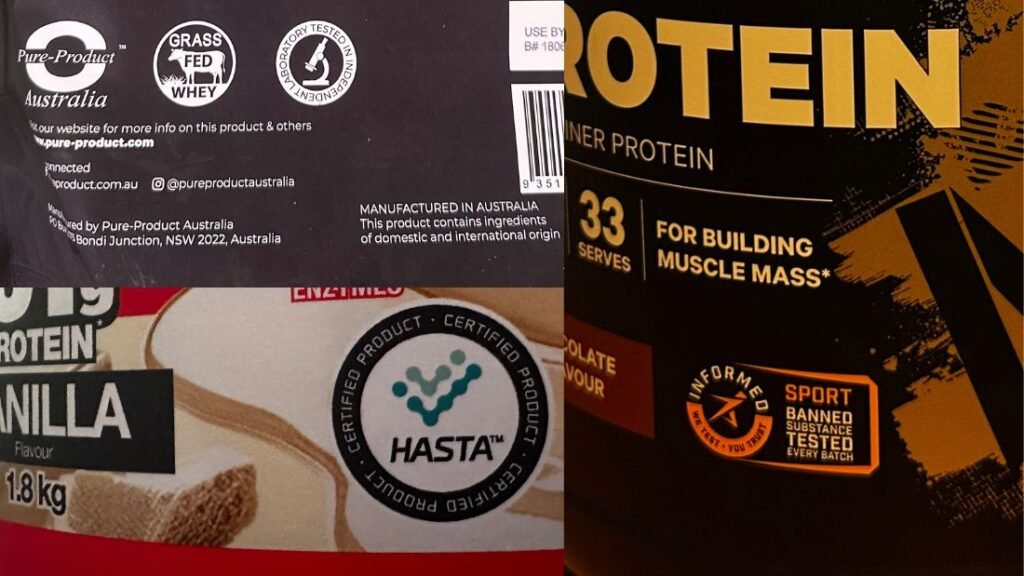
You’ll often see testing or quality claims on protein powder packaging or on brand websites. These aren’t all equal, but any form of testing is better than none.
Below are the most common labels you’ll see and what they actually indicate
| Label / Claim | What It Means | Who It’s For |
| HASTA Certified | Australia-based batch-testing for banned substances. | Competitive athletes, recreational athletes and everyday people. |
| Informed-Sport | International banned-substance testing. Highly recognised. | Competitive athletes, recreational athletes and everyday people. |
| NSF Certified | Independent lab checks for banned substances, contaminants & label accuracy. Highly recognised | Professional athletes or anyone wanting reassurance. Usually more expensive and the most thorough. |
| Third-Party / Batch Tested | Usually, independently verified protein content and purity. Still unbiased, and brands often publish results. | Consumers who want confidence and clarity in a brand/product. |
| In-House Lab Results | More control, faster results and often cheaper for the brands at large scale. Usually still publishing the results, slight chance of bias. | Consumers who trust the brand and still want confidence in the product. |
TIP:
Competitive athletes who are drug-tested prefer HASTA, Informed-Sport, or NSF label products for safety.
Ingredients & What They Do
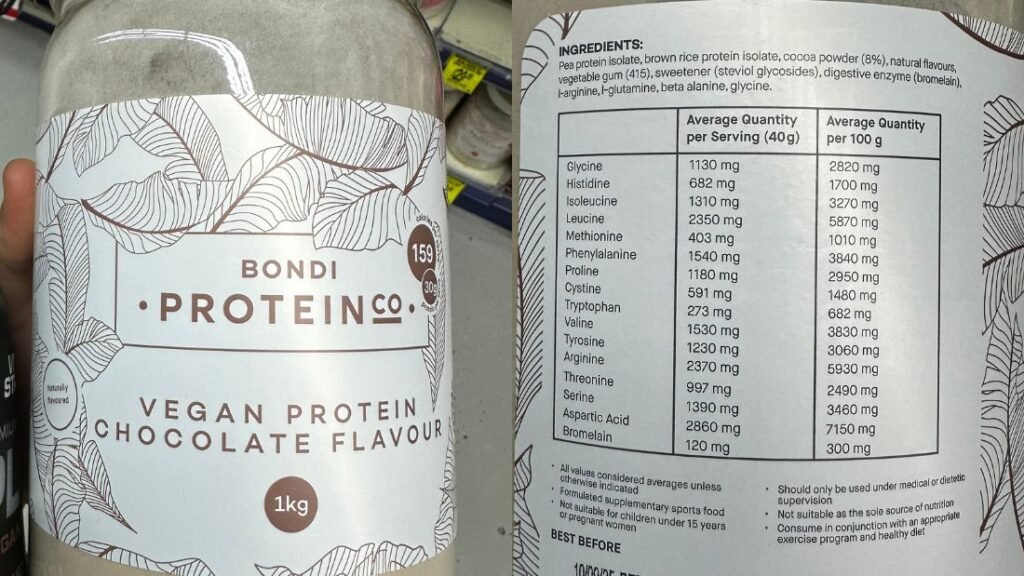
After choosing the protein type and checking the protein per 100g, it’s worth scanning the ingredient list.
None of these ingredients is inherently harmful, but simpler formulas are often easier to tolerate for some people.
| Ingredient | Purpose | Notes |
| Protein source (whey, isolate, plant blend) | Main protein | Essential; type affects protein %, digestibility, and taste. |
| Flavouring (cocoa, vanilla, etc.) | Taste and preferences | Often needed for a pleasant taste, common, safe, and just adds flavour. |
| Sweeteners | Adds sweetness without sugar or adding extra calories | Non-essential but common, safe and often makes a better tasting product. |
| Gums / Thickeners (xanthan gum, guar gum) | Texture, mixability | Some people may get bloating or gas, still generally considered safe. |
| Emulsifiers / Anti-caking agents (lecithin, others) | Helps powder mix, prevents clumping | Non essential but safe; functional only. |
TIP:
When mixing protein powder in a shake, add the liquid first to avoid clumping and powder stuck at the bottom.
Our Picks: Protein Powders in Australia
Here are two reliable, realistic options for buying protein powder in Australia that fit the framework above.
The goal isn’t to tell you what to buy forever, but to give you solid reference points so you can confidently assess your current brand or choose a new one.
Best Online Overall Value:
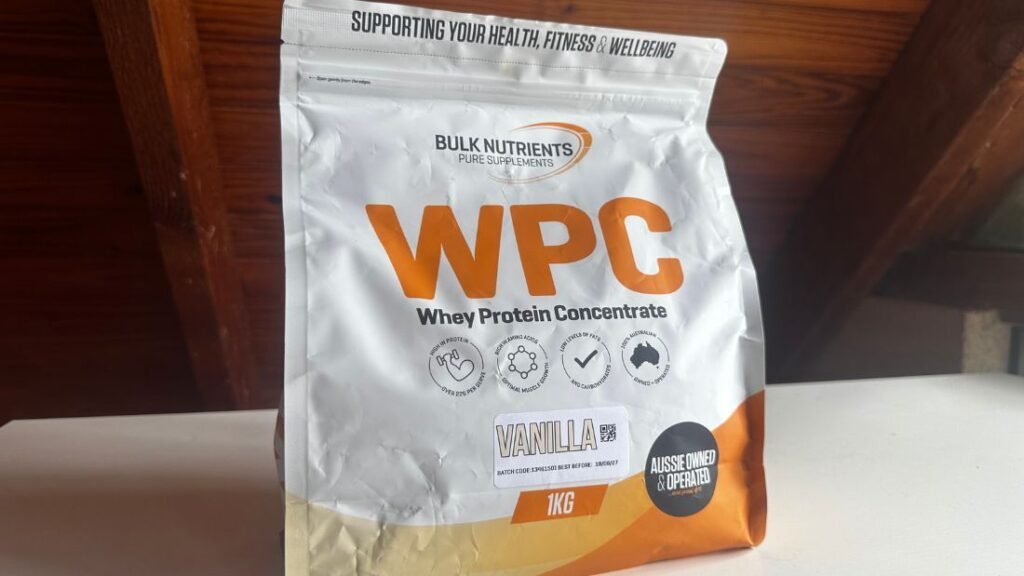
Bulk Nutrients Whey Protein Concentrate
Key points:
- Australian-made with clear, honest labelling
- High protein per 100g for the price (around 75g)
- Short ingredient list, minimal additives
- Consistent quality control with batch testing
- Very competitive pricing, especially in larger amounts
This is a strong option: affordable, well-made, properly tested, has a large range and focused on delivering quality protein without unnecessary extras.
After researching the Australian market, Bulk Nutrients consistently stood out for value, transparency, and simplicity.
They’re an Australian-based brand (Tasmania) with clear product comparisons, detailed nutritional information, and published testing results.
Their range covers most common use cases, and their website makes it easy to understand exactly what you’re buying and why.
See their full range | Get a free sample
Best Value In-Store Option:
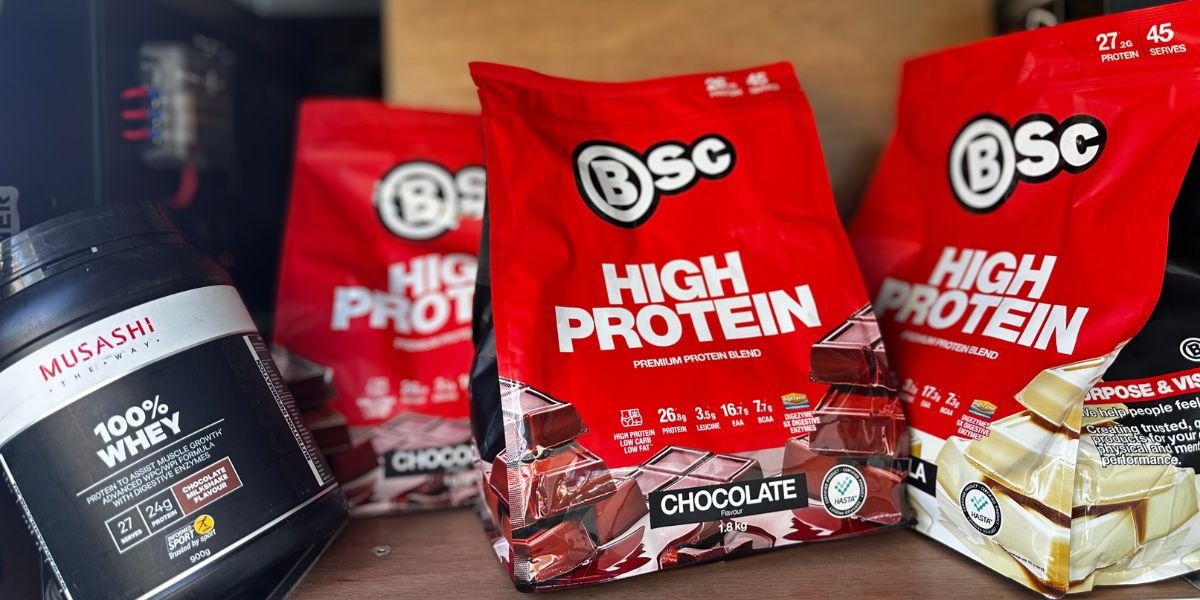
Chemist Warehouse – Musashi, Vital Strength, BSc, Optimum Nutrition
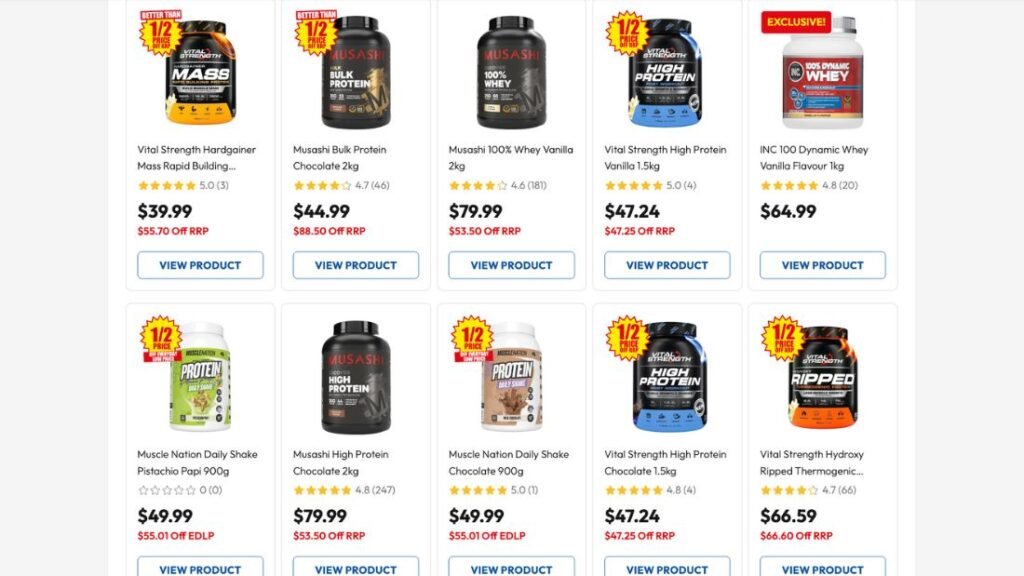
Example of in-store protein powder pricing at Chemist Warehouse (prices may vary).
Key points:
- Easy to buy in-store or online.
- Wide range of brands, types, and price points
- Many well-known, widely used products, including tested options
- Regular discounts and generally fair pricing
When I first started training, one of the simplest pieces of advice I got was not to overthink the brand. Walk into Chemist Warehouse, pick something on sale, and choose a flavour you’ll drink; chocolate or vanilla is usually a safe bet.
That approach still holds up. They regularly run promotions, especially around major sale periods, and the range is large enough to compare options without the pressure or overwhelm of a full supplement store.
It’s a practical choice if you want something accessible, familiar, and easy to buy locally.
Check current prices on their website or browse in-store.
Is This for You?
We have no affiliation with the products listed here; this guide is based on independent research and practical use.
Protein powder in Australia is safe, effective, and useful when chosen appropriately.
It’s most helpful if you train regularly, travel often, have busy days, or struggle to consistently hit protein targets through whole foods alone. Protein powder is designed to fill gaps, not replace proper meals.
Different brands, types, and formulas exist for a reason. If one doesn’t suit you, another likely will.
For more on supplements, see our guide, Common Fitness Supplements: Benefits and Use
Have any questions or suggestions? Feel free to contact us here.
References:
- Federal Register of Legislation (2015) Food Standards Code — Standard 2.9.4 — Formulated Supplementary Sports Foods. Available at: https://www.legislation.gov.au/F2015L00421/latest/text
- Food Standards Australia New Zealand (n.d.) Sports foods in Australia. Available at: https://www.foodstandards.gov.au/consumer/nutrition/sportfood?
- Therapeutic Goods Administration (n.d.) Sports supplements declared be medicines — not. Available at: https://www.tga.gov.au/news/news-articles/sports-supplements-declared-be-medicines#not
- Ambulkar, Pranit et al. “Efficacy and safety assessment of protein supplement – micronutrient fortification in promoting health and wellbeing in healthy adults – a randomized placebo-controlled trial.” Translational and clinical pharmacology vol. 31,1 (2023): PubMed Central. Available at: https://pmc.ncbi.nlm.nih.gov/articles/PMC10079511/
- Clean Label Project (n.d.) Protein Study 2.0. Available at: https://cleanlabelproject.org/protein-study-2-0/
- Jomova, Klaudia et al. “Heavy metals: toxicity and human health effects.” Archives of toxicology vol. 99,1 (2025): PubMed Central. Available at: https://pmc.ncbi.nlm.nih.gov/articles/PMC11742009/
- Human & Supplement Testing Australia (HASTA) (n.d.) Certified. Available at: https://hasta.org.au/certified/
- Informed Sport, Choice / We Test You Trust (n.d.) Sports supplements and testing. Available at: https://sport.wetestyoutrust.com/
- NSF International — Sport (n.d.) NSF Certified for Sport. Available at: https://www.nsfsport.com/
- Bulk Nutrients (n.d.) All products. Available at: https://www.bulknutrients.com.au/categories/all-products
- Bulk Nutrients (n.d.) Free samples. Available at: https://www.bulknutrients.com.au/free-samples
- Chemist Warehouse (n.d.) Protein category. Available at:https://www.chemistwarehouse.com.au/shop-online/400058/protein
Share with a mate: