
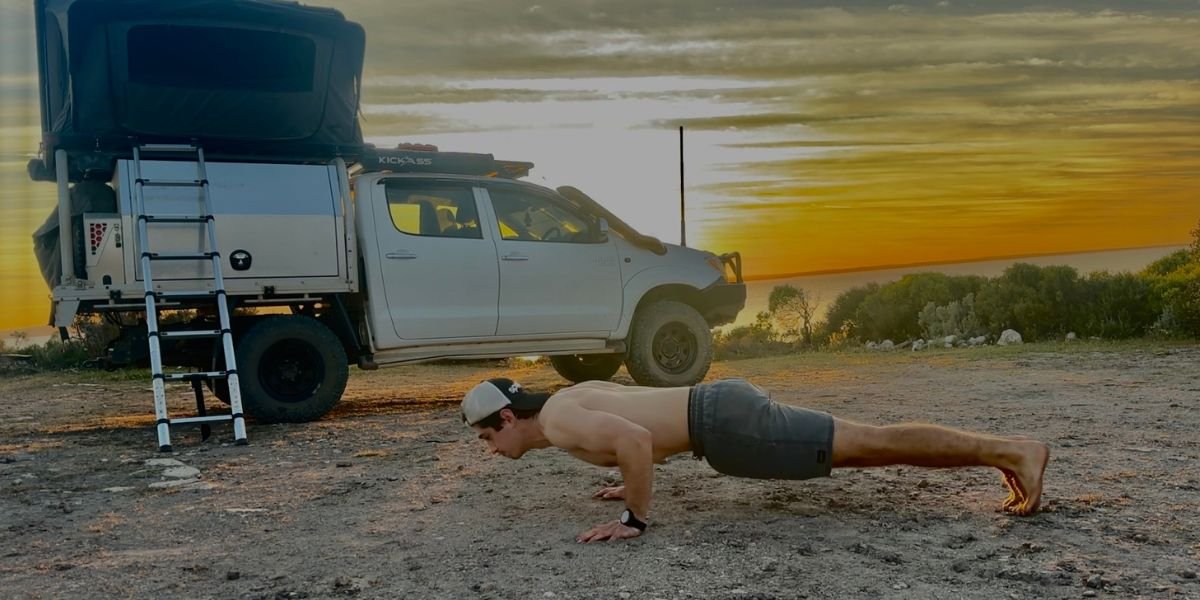
If you want to stay fit while travelling, you’re in the right place. Travelling doesn’t mean losing your gains; it just means taking a different approach to fitness.
I’ve spent the last nine months living in my car, and I’ve managed to maintain much of my fitness without a regular gym or training routine, and even improved in a few areas.
In this article, I’ll show you how that’s possible using the idea of the Minimum Effective Dose (MED). You’ll get a practical framework, examples, workouts and my personal experience of what I have been doing.
Whether you’re living out of a bag, a car, off-grid, or constantly on the move, there are options for you.
Let’s get into it.
Table of Contents
Disclosure: This post contains affiliate links. As an Amazon Associate, I earn from qualifying purchases at no extra cost to you.
What Staying Fit While Travelling Means
There is a lot of confusion about what staying fit means, especially when you’re trying to stay fit while travelling, because fitness can feel highly subjective. While the expression of fitness is personal, the principles are universal.
At its core, staying fit while travelling means sustaining your conditioning/endurance, strength, and mobility so you remain capable, resilient, and free from preventable setbacks.
For this reason, the three fundamental pillars for fitness are:
1. Cardiovascular Endurance
All forms of cardio and aerobic activity. This is your conditioning, what keeps you feeling fit and functional during hikes, runs, or long days on your feet.
2. Muscular Strength
Your size and strength. This keeps you physically resilient, strong, and looking fit.
3. Mobility & Flexibility
Your ability to move well. Mobility and flexibility protect you from injury, help you stay pain-free, and make it easier to handle the awkward positions and conditions that come with travel.
Want the full breakdown on what real fitness and all 10 components are? Check out What Is Real Fitness.
TIP:
If you’re new to this, start by focusing on just one pillar at a time.
How Do You Stay Fit While Travelling: Minimum Effective Dose (MED)

How you stay fit while travelling is as simple as focusing on maintenance rather than pushing for progress, which is achieved by using the minimum effective dose (MED) for your chosen discipline. For this reason and for the sake of simplicity, the rest of these examples will focus on this aspect.
All these recommendations and research come from sound studies, explained in detail in our last article, How to Maintain Fitness, where we covered each pillar thoroughly.
Keep in mind that a few extra factors can influence these, such as your age, fitness goals, and your current fitness level and training volume.
The table below is a recap from that post and can be seen as a general guideline, not a one-size-fits-all plan (see here for more specifics):
| Pillar | Frequency | Time Needed | Focus |
| Strength | 1–2x per week | 20–40 min/session | 1–3 sets per major movement, near-max effort. |
| Cardio | 2x per week | 15–30 min/session | High-intensity intervals or intense steady-state movement |
| Mobility | 1x per week | 5–10 min/session | Stretches targeting major joints and muscles. |
When to Start Using MED
Now that you know the Minimum Effective Dose for maintaining fitness, let’s talk about how to apply it while travelling, depending on the length of your trip.
- Short trips (under 2 weeks): Usually, no problem for your gains. The break can even help with your rest and recovery, especially if you’ve been training hard.
- Longer trips (2–4+ weeks): This is where you’ll start to lose strength, endurance, or muscle if you do nothing. Using MED strategies keeps your base fitness intact.
TIP:
It’s often the lack of routine, not equipment that will be the hardest to manage.
How to Train Based on How You Travel

Hitting the Minimum Effective Dose consistently is the way to stay fit while travelling long-term. The application method will depend on your travel style, location, and available resources.
Practical Framework: making your plan
Use the framework below to help plan fitness into your trip and find what workouts you can do to stay fit while travelling:
- Location
Find realistic places to train. Google search for gyms near me, outdoor gyms, parks, rock climbing/bouldering gyms or yoga studios.
You can also train anywhere outside, as long as you have the space or inside your accommodation, using just a quiet corner and simple furniture.
(more examples below)
- Equipment / Gear
Know what you have or can carry. Are you comfortable training with just your body weight, or do you want some weights/resistance?
Ensure you have a way to train your back with some type of equipment; finding pull-up bars, carrying a set of gymnastics rings, a strong band, lifting heavy objects like a bag, or having somewhere to do inverted bodyweight rows, eg using a table or chairs.
(more examples below)
- Time / Schedule
Plan one week at a time and look at your days realistically. Block out time for workouts and stick to your plan as best as possible.
When things come up, adapt and again just focus on one week at a time, meaning if you miss one day you had planned, stay flexible and make time later in the week to hit the minimum.
Also, testing your workouts before you leave (if you can) will be invaluable to see how long they take and how they feel, while also giving you time to adjust things if needed before you’re stressing on your trip.
(more examples below)
- Energy / Social Factors
Travel fatigue, new environments, and social interactions affect energy. Plan your workouts around these factors and try to be prepared.
Morning sessions are often best; you get them done before the day fills up and gets busy.
(more examples below)
TIP:
With no plan, you plan to fail.
Practical Framework Examples:

Here’s how the framework might look in action for different travel types. This is to help plan your approach, while the actual workouts are detailed in the next section.
Backpacker / Hostel Traveller
(Frequent moves, minimal gear, always around people)
- Location: Gyms near towns, hotel gyms, outdoor spots, or your room if quiet.
- Equipment / Gear: Mostly bodyweight; a backpack or suitcase can double as weights. Resistance bands add variety if you can carry them.
- Time / Schedule: Quick 15–30 min sessions in the morning before sightseeing or travel.
- Energy / Social Factors: Crowded hostels and travel fatigue can drain motivation. Stick to your plan and embrace quiet spaces for training when needed.
Tip: Walking is a good means of transport/sightseeing, which will help you stay active, although that alone is insufficient for holding your conditioning.
Vanlife / Car Camping
(Mobile, flexible, more space for gear, mix of cities + nature)
- Location: Campsites, beaches, open spaces, or beside your vehicle. Use trees, benches, and picnic tables creatively.
- Equipment / Gear: Can carry small gear like resistance bands, rings, rope, or a yoga mat. Use nature and everyday items for resistance. (more examples under creative options)
- Time / Schedule: Stretching and mobility on travel-heavy days; strength and cardio when the day allows.
- Energy / Social Factors: Mostly solo training; treat workouts as resets rather than chores.
Tip: Set a simple weekly standard (e.g., 1 run + 1 strength session) and stick to it.
Stationary / Basecamp Traveller
(Caravan, Airbnb, long-term stays in one spot)
- Location: Local gyms, home setups, or outdoor spots. Consistency is easier with a fixed base.
- Equipment / Gear: Full gym access if available, or compact personal kit with dumbbells, bands, and a mat.
- Time / Schedule: 2–3 structured full-body sessions per week. More routine = more chance to progress.
- Energy / Social Factors: Social life may influence schedule, e.g. going out late or having friends over.
Tip: This is your chance to improve fitness, not just maintain it.
Adventure / Remote Traveller
(Multi-day hikes, expeditions, off-grid living)
- Location: Nature is your gym: trails, rivers, mountains, and open bushland.
- Equipment / Gear: Keep it light; rely on bodyweight, your pack weight, and natural objects.
- Time / Schedule: Kind of at the mercy of the adventure, with some training built into your day, hiking, climbing, and carrying loads. Make time to balance effort with recovery.
- Energy / Social Factors: Isolation and high physical demands require careful fatigue management. Listen to your body.
Tip: Prioritise recovery; stretch, eat, and sleep to the best of one’s ability.
Workout Examples: Full-Body Emphasis
No matter where you are or what equipment you have, focusing on high-effort full-body workouts is the most efficient way to maintain both strength and conditioning while travelling.
Pair this with mobility and stretching to keep your joints, muscles, and any tight areas healthy.
Below are practical full-body workout examples for travellers, tailored to different environments and the equipment you may have available.
Note: Supersets are where you do two opposing exercises back to back with no rest as a time-saving method (e.g. push and pull). You can also find the list of other key terms here to understand intensity, HR, 1RM, and other concepts.

Full Gym Access (Hotel Gym / Local Gym): Strength
MED reminder: 1–2x per week, High intensity effort (~75–85% 1RM, RPE 7–9), near-max effort.
| Block | Exercise | Sets x Reps | Notes |
| Core Activation / Maintenance | Hanging Leg Raise or Cable Crunch | 2×6-8 | Serves as a quick warm up and to activate the core before big lifts. |
| Lower Body / Big Compounds | Squat or Leg Press | 2-3×6-8 | High intensity (~75–85% 1RM). |
| Deadlift or Romanian Deadlift | 2×6-8 | High intensity (~75–85% 1RM) | |
| Superset 1: Push / Pull | Bench Press or Chest Press | 2-3×6-10 | Superset with pull for efficiency. High intensity (~75–85% 1RM). |
| Pull-Ups or Lat Pulldown | 2-3×6-10 | High intensity (~75–85% 1RM). | |
| Superset 2: Push / Pull | Overhead Press | 2-3×8-12 | Superset with horizontal row. High intensity (~75–85% 1RM). |
| Rows (machine, DB, or barbell) | 2-3×8-10 | Optional: If you have extra time or want a bit more volume. |
Notes:
- Total session time: 30–45 minutes. (test yourself beforehand)
- Supersets are optional but will save time.
Bodyweight Only (Outside or Inside): Strength
MED reminder: 1–2x per week, High intensity effort (~75–85% 1RM, RPE 7–9), near-max effort.
| Super-Set | Exercise | Sets x Reps | Notes |
| 1 | Jump Squats | 3 x 15 | Hard but not to failure |
| Push-Ups (wide/close or feet elevated) | 3 x 10–20 | Pull-up or Inverted Rows | |
| 2 | Walking lunges | 3 x 50 (25 per leg) | Hard, increase reps as much as needed |
| Handstand pushup or Pike Push-Ups | 3 x 8–12 | Regress as much as needed. | |
| 3 | Pull up or Inverted Rows | 3 x 8–12 | Finding something for pull-ups is best, but rows work too. |
| Glute Bridge / Hip Thrust | 3 x 12–20 | Optional – Could do one of the core exercises here instead. | |
| Core | 1. L-sit / V-sit up/ pike pulses/crunches or hanging variations. 2. Regular plank/Side Plank/ dead bug/flutter kicks | 3 x 30–45 sec | Choose your two favourite core exercises from each 1. and 2. |
Notes:
- Rest only 30–60 seconds between super-sets.
- Reps are approximate; adjust to suit for difficulty, focus on making it a hard effort with good form, and going close to failure rather than hitting exact numbers.
Cardio-Focused (Running / Conditioning): Cardiovascular Endurance
MED Reminder (Cardio): 2x per week, 15–30 min per session, high-intensity intervals or intense steady-state movement.
| Exercise / Activity | Duration / Sets | Notes |
| Running | 15–30 min | Use intense steady-state training, hills, or intervals. e.g 5 min warm up, then: 30 secs fast, 10 secs recovery, repeat 6-12 rounds. Or run up a hill for 30 seconds and jog back down, repeat 6-12 times. |
| Cycling | 15–30 min | Use intense steady-state, hills or intervals similar to running. |
| Swimming | 15–30 min | Continuous laps or short sprints. Focus on effort. (High-intensity) |
| Rowing Machine Intervals | 15–30 min | High-intensity intervals: e.g., 500m hard / 90s rest x 3–4 rounds or more. |
| Jump Rope | 15–20 min | Fast-paced or interval style. Can split into 1–2 min rounds. |
Mobility & Stretching
MED Reminder (Mobility): 1x per week, 5–10 min/session, stretches targeting major joints and muscles.
| Exercise / Activity | Duration / Sets | Notes |
| Hip Flexor Stretch | Keep back flat, hinge from the hips. | Hold and breathe deeply. |
| Hamstring Stretch | 30 sec – 1 min | Keep back flat, hinge from hips. |
| Shoulder Opener (hands on wall) | 30 sec | Open chest and shoulders. |
| Cat-Cow Flow | 8-10 reps | Spine mobility. |
| World’s Greatest Stretch / Thoracic Rotations | 5-10 each side | Full-body mobility, hips + thoracic. |
| Neck Stretches (up, down, left, right) | 15 sec x 2 | Use your hand for an extra stretch. NOT rolling the neck. |
| Lying Figure-Four Stretch or Pigeon Pose (glute stretch) | 30 sec | Alternatively, can do the standing Figure-Four Stretch. |
| Child’s pose | 1 min | Hold as long as you like. |
Notes:
- Total session time: 10 minutes.
HIIT (High-Intensity Intervals)
Why it works: HIIT is an effective time saving method and stimulus for both cardio and muscle maintenance.
| Option | Exercises | Notes / Timing |
| Bodyweight HIIT | 1. Burpees 2. Jump Squats 3. Push-Ups 4. Rows 5. Mountain Climbers | 30s work for each exercise / 15s rest after all 5 exercises, repeat 4–6 rounds. |
| Gym HIIT | 1. Row 250m sprint 2. Kettlebell Swings x 15 3. Dumbbell Thrusters x 12 4. Box Jumps x 10 | Rest 1 min between rounds, repeat 3–4 rounds. |
| Cardio-Focused, Outdoor HIIT | 1. Sprint 30s – Walk 10 sec x 6-12 2. Hill Sprints x 6-12 3. Stairs 30s max – walk down x 6-12 | Use natural terrain and surroundings; keep intensity and HR high. |
Creative / Outdoor Options

These aren’t strict workouts; think of them as ideas to add variety, have fun, adapt to your environment, and find new ways to stay fit while travelling.
You can use them as add-ons to your routine or turn them into standalone sessions, as long as you still hit each main muscle group at least once per week.
For example, when I find a decent rock, I might incorporate it into a HIIT session, doing rock throws or make it into its own session like these rock lifts/shouldering rocks (image above).
Here are some options and how you might use them:
Logs:
Logs and fallen branches for back squats, zercher squats (front-loaded squats), rows, or overhead presses.
Basically, an awkward-sized barbell. Size can be deceiving; choose wisely.
See my demonstration: here
Rock:
Great for goblet squats, overhead throws (like wall balls without a wall), isometric holds, grip training, lifting, carrying, or tossing a heavy rock repeatedly challenges strength, coordination, and stability.
They can be used just like any dumbbell or weighted ball. Look for smooth rocks, not sharp ones.
See my demonstration: here
Packs / Bags / Water Container:
Backpacks, 4×4 recovery bags, or water containers can be used as weights for swings, presses, rows, front-loaded squats, back-loaded (if using a backpack), carries, or loaded walks.
Similar to a kettlebell or dumbbell, and easy to adjust for weight. Size might be an issue for some, depending on your bag.
See my demonstration: here
Tables / Benches:
Park benches, picnic tables, or sturdy furniture are perfect for step-ups, box jumps, incline or decline push-ups, dips, or inverted rows.
A simple way to train both the upper and lower body can be found in most parks.
See my demonstration: here
Playgrounds / Callisthenics Parks:
Monkey bars, pull-up bars, and climbing frames are ideal for pull-ups, chin-ups, muscle-ups, inverted rows, as well as any other bodyweight exercises, including push-ups, handstands, or balance drills.
Excellent for bodyweight strength and typically available for free.
See my demonstration: here
Trees:
Stable tree branches can be used for pull-ups, dips, dead hangs, or hanging gymnastics rings to perform more advanced moves such as muscle-ups.
Trees provide a versatile way to train pulling and pushing movements when there are limited structures around.
See my demonstration: here
Trails / Hiking:
Use any trails you see for day hiking, trail running, hill sprints, walking lunges, or stair climbing. Apps such as AllTrails can help you find and navigate them.
Fantastic for lower-body endurance, cardio, and functional strength while exploring a new area.
See my demonstration: here
Swimming:
Pools, lakes, rivers, waterfalls, and safe ocean spots are excellent for low-impact cardio, full-body conditioning, and mobility.
You can do interval training, long-distance swims, or simply use it as active recovery while enjoying your surroundings.
Nutrition & Recovery While Travelling

Training is only half the story; How you recover and what you eat are just as important for staying fit while travelling long-term. Having a few non-negotiables and minimum targets for both will help you stay on track:
Nutrition basics:
Protein:
- Aim for around 1.6 g per kg of bodyweight per day, a research-backed target shown to support recovery, muscle maintenance, and performance. If you want the full breakdown of why this number works or how it might differ for you, see our Protein Essentials guide.
- Rely on repeatable staples that you can carry: tuna, protein powder, peanut butter, protein bars, oats with milk, eggs, etc. Depends on what you can carry/cook.
- Or look for high-protein options when buying food.
Calories:
- Eat enough to maintain weight. Add ~300–500 kcal on heavy training or long hikes (e.g., extra sandwiches or a protein shake).
- Use a calorie calculator to find a starting point and adjust based on energy, weight, and how you look.
Hydration:
- Aim to drink 2–3 L of water per day baseline, plus 500ml-1L extra per hour of heavy sweating.
- Add electrolytes or a pinch of salt on hot days to maintain mental sharpness.
Caffeine:
- Limit to 200–300 mg daily (2–3 coffees or a strong energy drink).
- Use before workouts or long drives, avoid late-day consumption, and don’t rely on it to mask fatigue.
Alcohol:
- Best avoided. It reduces recovery, lowers sleep quality, and leads to poor decision-making (food, safety, training discipline). 2 drinks per week is the upper limit if you must.
- Skipping alcohol keeps your body, performance, and wallet in better shape.
TIP:
Know your limits and do your best.
Detailed nutrition strategies in a full post soon. For now, focus on these basics and try having fun without alcohol or overeating.
Recovery Basics
Until you really settle into your trip, your recovery will most likely suffer a little from all the new stimuli.
Travel disrupts habits, sleep, and routines. Carrying backpacks, sitting in cars, and extreme temperatures can impact recovery.
Don’t be too hard on yourself if it takes longer to recover from your training and travel.
Sleep:
- Aim for 7–9 hours per night (or your usual). If that’s not possible, use naps (20–40 min) to make up for poor nights (if possible).
- Using an eye mask and earplugs can help in noisy areas or on a long flight.
Mobility:
- 5–10 min daily stretching for hips, shoulders, and spine helps prevent stiffness.
- Yoga flows or longer stretching sessions for your areas prone to stiffness.
Listen to your body:
- Adjust intensity if you’re sore, stressed, or underslept. Swap heavy sessions for mobility, walking, or easy cardio.
- Make sure to plan rest days when you can, from both travel and training.
TIP: Travel Stress adds more fatigue and also greatly affects your recovery and output.
For more on rest and recovery, see this post here.
Personal Experience: Travelling Around Australia

Knowing the principles of training, nutrition, and recovery is one thing; applying them while travelling is another.
Over the past nine months, living out of my car while solo travelling around Australia, I’ve been learning how to stay fit while travelling, what works, what I enjoy, and how to stay consistent without a regular routine.
I’ll be sharing a more detailed breakdown in a few more months once I finish this trip and have the chance to properly re-test myself, which will show whether I’ve truly managed to stay “fit.” For now, here’s what I’ve been learning.
I’ve also been posting workouts and creative training ideas on my Instagram (@justmaxhamra), using it as a running log of this experiment and my fitness journey.
What’s Worked for Me:
The Golden Rule: “Never Two”
- I never let poor food choices or an inactive day happen two days in a row.
- Travel is unpredictable. This is a simple way to stay on track and keep momentum building, even if you fail one day.
Minimum Standards:
- MED in practice: I use the “minimum effective dose” rule flexibly, sometimes doing much more or a little less, but never breaking my personal minimum standard of one each per week. More realistically, what I’ve been doing each week: at least 1-2 runs, 1-2 strength sessions, and 2-3 mobility/stretches/yoga sessions per week.
- To hit that MED sometimes meant I was running in circles around my campsite or sprinting back and forth for 1km as the sun set on a Sunday night. Example: here
- Short, flexible sessions: Some days, I break workouts up between the morning and afternoon. Example: start with 15 muscle-ups in the morning, finish with 50 pull-ups and 50 chin-ups later in the day.
- Extra when energy allows: Some weeks I do much more than the minimum, back-to-back long hikes, extra reps and volume, or personal challenges like 100 push-ups in a row or 500 walking lunges. Finding fun ways to challenge myself.
Creative Training & Improvisation:
Objects as equipment:
- 4×4 recovery bag (10 kg) – as a kettlebell.
- 20 L water jerry can – as a good weight for rows, squats, or carries.
- Rocks – one of my favourites is for things like throws, lifts, and as weights for squats.
- Logs – presses, squats, or pull movements (although finding a good one can be hard).
- Gymnastic rings– Hung from my car or trees for pull-ups, dips, and muscle-up practice. Also, I have used them for balecing pushups.
- Outdoor stops: If passing a town with dip bars or an outdoor callisthenics park, I almost always stop for a quick session, and I find it breaks up the drive nicely.
- Extra movement: Air squats while brushing teeth, pacing around the car during phone calls or thinking.

My Go-to exercises anywhere:
To list a few of my top picks:
- Walking lunges (high reps).
- Pull-ups and chin-ups, using my rings or bodyweight rows off my car.
- Push-ups (high rep sets), handstands practice.
- L-sits and dragon flag.
- Burpees, air squats, bag swings and HIIT-style circuits.
My Go-to Endurance/Cardio Activities:
- Running: Beach runs, bush trails, road running, long-distance fun runs (e.g., 19 km to a waterfall or a 25 km on my birthday).
- HIIT & hiking: Weekly HIIT sessions and finding long 10–15 km day hikes.
- Swimming: Pools, gorges, lakes, hot springs, or safe open water ocean swims for low-impact cardio and recovery.
Safety & practicality:
These factors need careful consideration to stay safe if you’re alone, especially in new and remote areas.
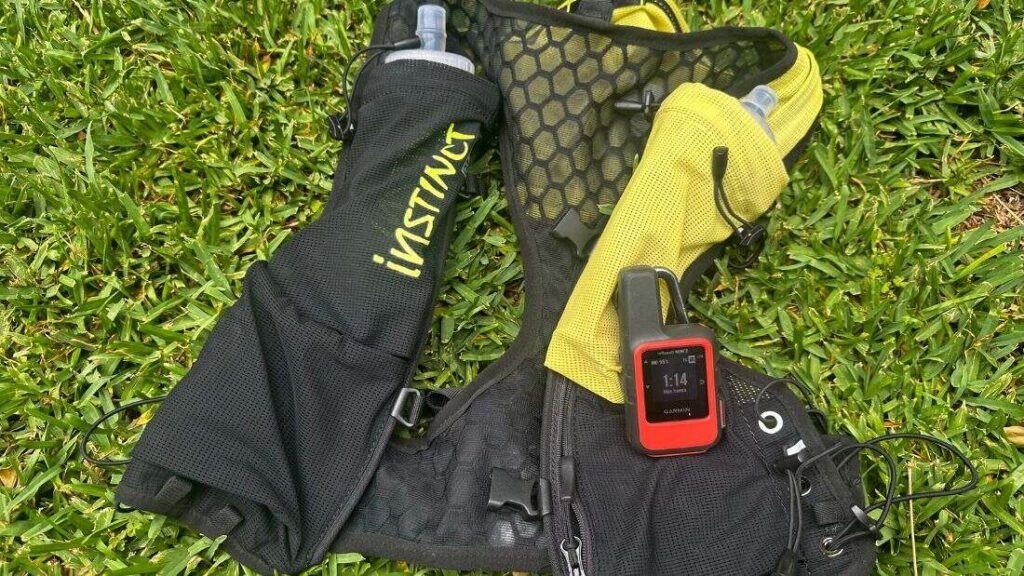
- Always tell someone where you are going and consider carrying a PLB or satellite communicator on remote hikes and runs. I personally used the Garmin InReach Mini for its satellite messaging and SOS function (needs active subscription), location sharing, navigation and weather checking abilities when there is no mobile reception.
- Running vest or backpack for water, snacks, a first aid kit, PLB/satellite communicator, keys, phone, power bank, headtouch, etc.
- Rain gear: A quality raincoat, a dry bag for electronics, and a hiking bag rain cover if needed.
Food & Recovery:
- Food: Travelling in a car, I have a fridge and also have room to carry a fair supply of staple nutrition and repeatable high-protein foods: tuna, eggs, fish, meats, protein powder, trail mix, cheese, peanut butter, oats, milk, wholemeal bread, etc., hitting 100 g+ protein daily. See some stats here
- Travel limitations: Long drives (4+hrs a day) and one-night stops impacted my recovery/sleep and energy. I now aim for 2-3 hours driving per day, where possible, and 2-3 nights in one spot is ideal for me.
- Sleep & rest: Sitting in my car for hours, bad back suport in my camp chair, sleeping in my roof top tent, which is especially bad in extreme weather, where windy and rainy nights make it hard to sleep, as well as both hot and cold nights, all impact my sleep and slow down my recovery, as it is taking me longer to recover from such simple training.
Tracking Progress:

- Tech: Using the Garmin app paired with my Garmin finix Pro watch was how I tracked everything from runs, hikes, workouts, sleep/recovery and even stress. The images above are data from the Garmin Connect app, showing my current “training status”, VO2 max trend (measurement of cardiovascular fitness), and HRV trend (sleep/recovery).
- Doing so, I noticed my VO₂ max gain +2 points in the last 6 months, and my HRV and sleep dipped on extra stressful days/weeks and on cold, rainy, windy nights.
- Video: Having old and new videos of exercises I’m doing, to monitor form and to check for regression, as it’s hard to tell sometimes.
- Logging: Workouts, food, hydration, and sleep/recovery tracked in a Google Sheet to fine-tune habits and maintain consistency. Something I have only started doing in the last 2 months, and will fine-tune it before sharing it. (Stay tuned for a later breakdown)
Summary:
Travel tests your commitment to fitness like nothing else, but it is absolutely possible to stay fit while travelling, even long-term. In fact, it often takes less time than you think and can be more creative, fun, and rewarding than you imagined.
What matters most is a clear plan built around how you will travel and the three fitness pillars: strength, cardio, and mobility. Combine that with the Minimum Effective Dose approach, and make it your baseline standard.
Nutrition and recovery are just as important. Listen to your body and adjust when needed. No strategy guarantees perfection, but building these habits will get you close, as long as you put in the work.
Fitness should travel with you, not against you.
Keep following PioneerGains for practical tips, real experiences, and science-backed advice to stay fit and strong wherever you go. There’s plenty more to come.
Have any questions or suggestions? Feel free to contact us here.
References & Further Reading:
These studies provide the scientific basis for the strategies shared in this guide. You can use them to understand the principles behind strength, cardio, mobility, and minimum effective dose (MED) training while travelling long-term.
For a deeper dive into the research and practical tips, see my full post: How to Maintain Fitness. Alternatively, see the studies used in that post below.
Studies cited for MED:
- Spiering, Barry A.; Mujika, Iñigo; Sharp, Marilyn A.; Foulis, Stephen A. Maintaining Physical Performance: The Minimal Dose of Exercise Needed to Preserve Endurance and Strength Over Time. Journal of Strength and Conditioning Research Supports the idea of Minimum Effective Dose workouts for preserving strength and endurance.
Read the full study - Milanović, Z., Sporiš, G. & Weston, M. Effectiveness of High-Intensity Interval Training (HIT) and Continuous Endurance Training for VO2max Improvements: A Systematic Review and Meta-Analysis of Controlled Trials. Supports the effectiveness of HIIT and high-intensity cardio training recommendations in this guide.
Read the full study - Ingram LA, Tomkinson GR, d’Unienville NMA, Gower B, Gleadhill S, Boyle T, Bennett H., 2025 – Optimising the Dose of Static Stretching to Improve Flexibility: A Systematic Review, Meta-analysis and Multivariate Meta-regression
Supports the mobility and stretching advice included in the framework.
Read the full study - Lesley A. Ross, Erica L. Schmidt, Karlene Ball, 2013 – Interventions to Maintain Mobility: What Works? Accident Analysis & Prevention, Volume 61.
Supports the mobility and functional movement recommendations in this guide.
Read the full study

Pingback: 5 Types of Strength Training and What They Do